Mostrando las entradas con la etiqueta Alternative medicine. Mostrar todas las entradas

20 octubre, 2011

The Prostrate Placebo

Serenoa repens, Arecaceae, Saw Palmetto, habitus.Image via Wikipedia
 a tennis ball, I am going to go looking for a therapy that will shrink it, not fool me into thinking I can write 
Science Based Medicine
I seem to be writing a lot about the urinary tract this month. Just coincidence, I assure you. As I slide into old age, medical issues that were once only of cursory interest for a young whippersnapper have increasing potential to be directly applicable to grumpy old geezers. Like benign prostatic hypertrophy (BPH). I am heading into an age where I may have to start paying attention to my prostate (not prostrate, as it is so often pronounced, although an infection of the former certainly can make you the latter), so articles that in former days I would have ignored, I read. JAMA this month has what should be the nail in the coffin of saw palmetto, demonstrating that the herb has no efficacy in the treatment of symptoms of BPH: Effect of increasing doses of saw palmetto extract on lower urinary tract symptoms: a randomized trial.
It demonstrated that compared to placebo, saw palmetto did nothing. There have been multiple studies in the past with the more or less the usual arc of clinical studies of CAM products: better designed trials showing decreasing efficacy, until excellent studies show no effect. There is the usual meta analysis or two, where all the suboptimal studies are lumped together, the authors bemoan the quality of the data, and proceed to draw conclusions from the garbage anyway. GIGO.
The NEJM study from 2006 demonstrated that saw palmetto was no better than placebo but it was suggested that perhaps the dose of saw palmetto was not high enough or that the patients were not treated long enough to demonstrate an effect, and the JAMA study hoped to remedy that defect.There is, as is often the case, no good reason to suspect that saw palmetto would benefit or harm the prostate. Like many herbal preparations, it had widespread uses back in the day, when I had an onion tied to my belt, which was the style at the time. You couldn’t get white onions, because of the war. The only thing you could get was those big yellow ones.., but I digress:
“It is also an expectorant, and controls irritation of mucous tissues. It has proved useful in irritative cough, chronic bronchial coughs, whooping-cough, laryngitis, acute and chronic, acute catarrh, asthma, tubercular laryngitis, and in the cough of phthisis pulmonalis. Upon the digestive organs it acts kindly, improving the appetite, digestion, and assimilation. However, its most pronounced effects appear to be those exerted upon the urino-genital tracts of both male and female, and upon all the organs concerned in reproduction. It is said to enlarge wasted organs, as the breasts, ovaries, and testicles, while the paradoxical claim is also made that it reduces hypertrophy of the prostate. Possibly this may be explained by claiming that it tends toward the production of a normal condition, reducing parts when unhealthily enlarged, and increasing them when atrophied.”
At the turn of century Edwin M Hale, MD and homeopath, wrote a treatise on the topic, extolling its benefits on the prostate and other organs. You will be happy to know that if you have testicular atrophy from being an old masturbator, saw palmetto will help. For no good reason I can find, it became popular only for BPH. As best I can determine from the internet, there was a natural medicine fad in the early 1900’s, and saw palmetto became part of the fad. No clinical trials were responsible for the use. And, like acupuncture and homeopathy, there are many explanations for an efficacy that does not exist.
The JAMA study followed 369 men for 72 weeks. They received placebo or saw palmetto twice a day, and at weeks 24 and 48 the dose of each was increased.
They were followed for subjective complaints with the AUASI score, which is a 7 question self administered questionnaire:
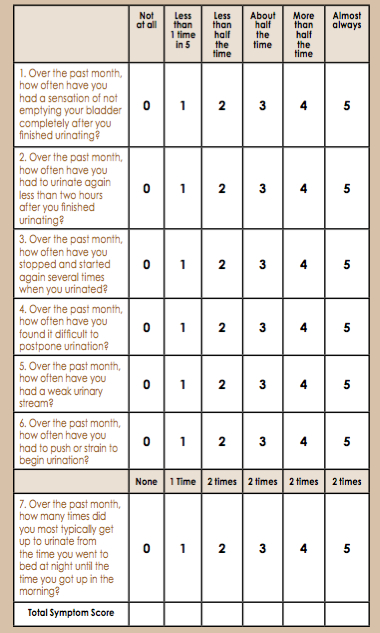
Well validated as a tool for BPH symptoms, it relies overmuch on memory and is subject to wishful thinking on the part of the test taker. I doubt I could ever accurately remember my urinary patterns over the prior month without writing it down.
There were also objective endpoints like peak urine flow, PSA levels, and post void residual. Makes me wonder again what they want done when the radio advertisement says ‘Void were prohibited by law.’ Would saw palmetto make that easier? When it came to the subjective measurements, there was a slight, and similar, improvements in both groups. Objective, anatomic and physiologic endpoints were not affected. No surprise. So much for the powerful placebo.
Adverse effects were the same in both groups, with the only significant difference that the saw palmetto group had more physical injury and trauma. Was this the dreaded nocebo effect, or the random badness that occurs as a result of life? Probably the latter.
Based on the JAMA and NEJM trials, it is reasonable to conclude that saw palmetto has no efficacy in the treatment of symptoms due to BPH.
More interesting is what this article says about the so called placebo effect. This is yet another article that demonstrates that for hard endpoints, altering abnormal physiology or anatomy, placebo does nothing. I bet if we did brain scans of these patients they would show changes when the patient took the medications, and to that I would yawn. Do anything to anyone, give a placebo, tickle their feet, there will be changes in the brain. And while in some studies, increasing placebo amounts and frequency leads to increasing effects, in this study an increase in placebo dose led to no improvement in subjective outcomes.
More real world data to suggest that there are no real placebo effects.
Of course, I have bias. I have spent 30 years in acute care hospitals. My patients have derangements of anatomy and physiology that, if not corrected or at least ameliorated, lead to death or permanent morbidity. Placebo isn’t going to cure endocarditis, stop a gastric ulcer bleed, or reverse a stroke. And even if the patient feels better from the therapeutic relationship, if the anatomic/pathophysiologic abnormalities continue unabated, the patient is toast.
I am not even certain it can be said that placebos cure gastric ulcers. There is little on the natural history of ulcers in the flexible endoscopy age. The only reference I could find suggests that patients who have ulcers found with x-ray screening (not a reliable way to diagnose ulcers and probably under-represented the incidence) and who are not treated had a 24% cure rate at 6 months and a 29% relapse rate at 24 months. Most of the placebo trials followed patients around 4 weeks and had a higher cure rate in the placebo wing than seen in the natural history report, but the two are not directly comparable. Given the propensity of untreated ulcers to come and go and the unreliability of symptoms for diagnosis, unless there was a study that had a treatment, a placebo, and a no intervention arm, I do not think it is reasonable to conclude that placebos ‘cure’ ulcers. Especially given the NEJM review that suggested that placebo is usually no more effective than a no treatment/waiting arm.
Perhaps it is me. I do have some intellectual blind spots, like the anthropic principal. Every time I come across it in a cosmology book, I think that it is inane. I lack the imagination, or perhaps I am not stoned enough, to recognize its significance. So too with the placebo effect.
Placebo effects are probably more like quantum mechanics. The single slit experiment gives key insights into the fundamental nature of reality, but in the macroscopic world of day to day life my electrons move about just fine to heat my house and run my computer. No need to worry about probability functions, I can throw potatoes at a slit all day and never see a interference pattern. So too with the placebo effect. Most of the practical effect is lost in the noise of the complexity of illness, especially in the acute care hospital where I spend most of my time.
the take-home message for clinicians, for physicians, for all health professionals is that their words, behaviors, attitudes are very important, and move a lot of molecules in the patient’s brain. So, what they say, what they do in routine clinical practice is very, very important, because the brain of the patient changes sometimes… there is a reduction in anxiety; but we know that there is a real change…in the patient’s brain which is due to… the ‘ritual of the therapeutic act.’
I do not disagree with that. I consciously try to accentuate just those interactions with every patient, because I know my job as a physician is more than ‘Me find bug, Me kill bug. Me go home’. But I do not think it is important for modifying any disease process I am involved with. Grooming each other has salubrious effects in monkeys, and as best I can tell, the placebo is no more than evolutionarily advanced nit picking.
Large swaths of the world rely on native healers and the only tool in their armamentarium is the “ritual of the therapeutic act.” And across the world and throughout time, people have suffered and died in droves. You may argue that is not a fair comparison, people suffered from poor hygiene, no vaccines, malnutrition and no health infrastructure. But the US has a group whose health care is only placebo, relying entirely on the ritual of the therapeutic act, and despite being surrounded by the benefits of western societal infrastructure, they die faster and younger: Christian Scientists.
At the end of the day, the practice of medicine is practical endeavor. I am a builder, not an architect. I have to try to make my patients better objectively and subjectively, and the placebo is a tool that has little utility in my toolbox. When my prostate grows to the size ofmy nam
e in the snow a little better.

14 julio, 2011

Placebo , another point of view

Classification of complementary and alternativ...Image via Wikipedia

The Rise of Placebo Medicine

Published by Steven Novella under Politics and Regulation,Science and Medicine 
It is my contention that terms such as “complementary and alternative medicine” and “integrative medicine” exist for two primary purposes. The first is marketing – they are an attempt at rebranding methods that do not meet the usual standards of unqualified “medicine”. The second is a very deliberate and often calculating attempt at creating a double standard.
We already have a standard of care within medicine, and although its application is imperfect its principles are clear – the best available scientific evidence should be used to determine that medical interventions meet a minimum standard of safety and effectiveness. Regulations have largely (although also imperfectly) reflected that principle, as have academia, publishing standards, professional organizations, licensing boards, and product regulation.
With the creation of the new brand of medicine (CAM and integrative) came the opportunity to change the rules of science and medicine to create an alternative standard, one tailor made for those modalities that do not meet existing scientific and even ethical standards for medicine. This manifests in many ways – the NCCAM was created so that these modalities would have an alternate standard for garnering federal dollars for research. Many states now have “health care freedom laws” which create a separate standard of care (actually an elimination of the standard of care) for self-proclaimed “alternative” practices.
But perhaps the most insidious and damaging double-standard that is being advocated under the banner of CAM is a separate standard of scientific research itself. The normal rules of research that have evolved over the last few centuries are being subtly altered or discarded, with clever newspeak. It is a way for proponents to choose their evidence, rather than having the evidence decide what works and what does not work. We saw this strategy at play with the recent acupuncture study for back pain that clearly showed acupuncture was no more effective than placebo acupuncture. Proponents (propagated by an uncritical media) turned scientific logic on its head by interpreting this result as indicating that placebo acupuncture must work also (if only we could figure out how, they unconvincingly mused).
We see this strategy at work also with the use of so-called “pragmatic” studies – a rebranding of “unblinded” studies. This is a way to choose their evidence – in this case, poorly controlled unblinded studies that are more likely to reflect the bias of the researchers and therefore give them a result that they like. This is their reaction to well-designed placebo controlled trials that show their preferred modality does not work.
Another strategy is to change the meaning of the concept of placebo effects. This one was ready-made, and most people grossly misunderstand the nature of “the” placebo effect. One of my first articles for SBM was about the placebo effect because this concept is so criticial to science-based medicine. To summarize – the placebo effect is really many effects. It is everything other than a physiological response to the treatment. It is not all a real effect of mind-over-matter – it includes every bias and artifact of observation as well. It includes things like subjects reporting they feel better to the researcher because they want the treatment to work and they want to please the authority figure, who also wants the treatment to work and may be encouraging the perception of benefit.
It is most important to understand how the term “placebo effect” is used in the context of a controlled clinical trial. Scientific methodology is about controlling variables – because we want to know which variables work and which ones do not. In any clinical scenario there are a multitude of variables that may affect the outcome or the perception of the outcome. Therefore a well-designed study maximally controls all the variables – ideally so that the one variable of interest (the treatment) is completely isolated. This is accomplished in a number of ways. One method is randomization – randomly assigning subjects to the various treatment and placebo arms of a clinical trial. Randomization combined with sufficiently large trial size (number of subjects) results in all variables not specifically controlled for averaging out among the various arms. Another way to look at is that randomization prevents systematic biases in who gets treated and who gets a placebo from affecting the results.
Another method of controlling variables is the double-blind placebo control. Ideally one group of subjects will receive the treatment being studied while another group will receive a treatment that is identical in every way except that it is inert (i.e. it controls for all possible variables and isolated the one variable of interest – the treatment). Both the subject and the examiner are blinded to which is which to control for psychological effects. In order to conclude that the treatment “works” those subject receiving the active treatment must do statistically significantly better than those receiving the placebo. If the activity of the treatment was the only variable, then we can confidently conclude it was responsible for the improvement.
I know this is all very basic, but it is these very basic concepts that are being challenged by proponents of so-called CAM. They are trying to say the the effect measured in the placebo arm of such studies is a real effect, something valuable and alone is sufficient to justify the treatment. This philosophy has been termed by critics “placebo medicine” and is just the latest attempt at creating a double standard. But the claim is utterly ignorant of the scientific nature of the placebo effect. It is a method of controlling for biases, artifacts, and variables (known and unknown) – it is not a real effect.
There may be some non-specific therapeutic effects mixed into placebo effects. For example, people who are being studied tend to take better care of themselves and are more compliant with treatments (because they are being watched). They may also feel better as a result of the positive attention from a health care provider – old-fashioned good bedside manner. These are some of the variables being controlled for. But it is scientifically absurd to argue that they justify an ineffective treatment. But that is exactly what CAM proponents are doing.
The latest manifestation of this strategy is a report put out in the UK by The Kings Fund – a health policy charity. They put together a committee to examine how the UK can find evidence to support CAM therapies. They are not interested in figuring out “if” such treatments work, but rather how they can show “that” they work. They report:
Explaining the need for different types of research when assessing complementary practice, Professor Dame Carol Black said: ‘It has become widely accepted that a stronger evidence base is needed if we are to reach a better understanding of complementary practices and ensure greater confidence in their clinical and cost effectiveness. The challenge is to develop methods of research that allow us to assess the value of an approach that seeks to integrate the physical intervention, the personal context in which it is given, and non-specific effects that together comprise a particular therapy.’
Got that? We need new kinds of research (read “double standard”) in order to demonstrate the value of these special CAM practices. The reason that we need to find new ways to demonstrate their value is because they fail under the accepted scientific methods. The last sentence is just a fancy way of saying that placebo effects should count as real effects.
‘As long as findings from research can provide confidence in the positive effect of the physical intervention at the heart of the treatment, then any added benefit brought by the therapeutic relationship and the context for treatment should count as part of the treatment effect,’ the report says.
‘For complementary therapies such a holistic approach to effectiveness should be adopted by bodies such as NICE, when comparing cost-effectiveness across a range of treatments.’
The “physical intervention at the heart of the treatment” is functionally the same thing as – non-specific placebo effects. They want to take a “holistic” approach to evidence (another useful marketing brand), meaning they get to decide what the evidence means. George Orwell would be proud.
As usual, Edzard Ernst (the go to expert for the media) gets it exactly right. He is quoted as saying:
‘This is the introduction of double standards through the back door.’
‘In this case we might as well allow an ineffective medication on the market, because it too will have a placebo effect.’
That latter point is a favorite of mine as well. Whenever CAM proponents try to change the rules of science to suit their needs, I invite my readers to imagine a pharmaceutical company getting away with the same thing (not that they wouldn’t want to if they could). Imagine a drug that works no better than placebo in well-designed clinical trials and the company trying to get FDA approval on the grounds that their drug has a valuable placebo effect, even if it is physiologically worthless.
Conclusion
The integrity of science-based medicine is critical to the health of the public, the legitimacy of modern medicine, and also the economic health of modern society (as is being forcefully argued recently). We need to have one scientific standard that is fair, rational, and scientifically sound. The creation of a double standard for proponents of modalities that do not meet the very reasonable standards of scientific medicine is eroding the standard of care and the integrity of modern medicine.
The public, the media, politicians, and regulators should not fall for the deceptive language that is being used to disguise the truth of these efforts to undermine science-based medicine. This is a brass attempt at changing the rules of science to meet their perceived needs. When you change the rules of science you no longer have science – you have pseudoscience or something even more nefarious.